
To the Teacher
The blog is designed for grades 3-4 and up but would be appropriate for any students in the upper grades who are not familiar with the morpheme being introduced. The main purpose of the blog is to develop students’ knowledge of bases (roots), prefixes, and suffixes so they can use these elements to derive the meanings of unfamiliar words and build their vocabularies. As part of presenting a new morpheme each week, words containing that morpheme are also introduced. Chances are some of those words will be unfamiliar, thus providing an opportunity for added vocabulary development.
This week’s lesson builds on last week’s introduction of the suffix –tion. The suffix –ate is often combined with the suffix – tion as in circulation and admiration. Students use their knowledge of the suffixes –ate and –tion to help them read challenging words as in this week’s article, ” Did Dinosaurs Walk in Your Drinking Water?” Words likely to be unknown are defined in context. Words that might be challenging to pronounce are phonetically respelled.
To the Student
Morphemes are meaningful parts of words. Base morphemes are the main parts of the word. They form a base for the addition of prefixes and suffixes. This week the suffix -ate is being introduced. The suffix –ate has a lot of meanings but often means “act on” or “make.” For instance, the word activate (activ (e)+ ate) means “to make active.” The word hyphenate (hyphen+ate) means “to make a hyphen.” The suffix –ate also forms verbs. The word active is an adjective but becomes the verb activate when the suffix –ate is added. The word hyphen is a noun but becomes the verb hyphenate when the suffix –ate is added. Syllable becomes syllabicate (syllab+ic+ate) and means “to divide words into syllables.” Circle becomes circulate (circul+ate), which means” to move around and around again as if in a circle.” Evaporate (e+vapor+ate) means to turn into vapor. Vapor refers to “droplets of water, such as steam or mist, that float in the air.” Here is a word that you have probably never seen or even heard before: paginate. What do you think it means? Pag is the word page without the e. The e is dropped, but in is added when –ate is attached. Paginate (pagin+ate) means “to make pages.” You would do this by adding page numbers. The suffix –ion can be added to words ending in –ate to turn them back into nouns. Activate becomes activation (activ(e)+at (e) + ion). Hyphenate becomes hyphen+at(e)+ion. Syllabicate becomes syllab+ic+at(e)+ion. Paginate becomes pagin+at(e)+ion.
Read to find out how it is possible that dinosaurs may have walked in your drinking water.
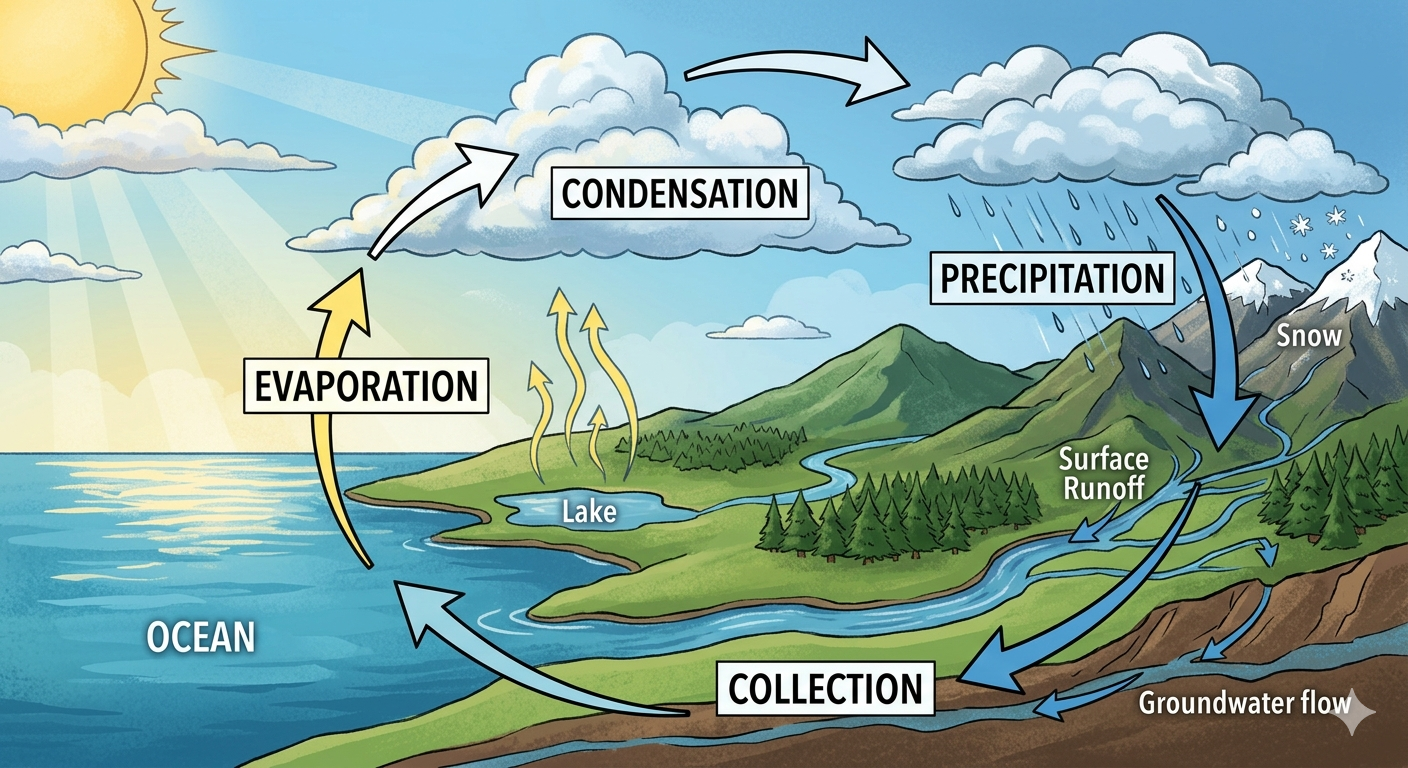
-Gemini Generated Image
Did Dinosaurs Walk in Your Drinking Water?
The water used to wash the carrots that you ate last night may have come from the Nile River in far-off Egypt. Water gets used over and over and over again. It circulates. It is constantly being recycled. In fact, dinosaurs may have walked in the water used to wash the carrots you ate for dinner last night. Water is in a cycle. The cycle goes around and around and never ends. The water cycle is complicated. It begins as precipitation (prih-sip-uh-TAY-shun). Precipitation is rain, snow, hail, or sleet that falls from the atmosphere (AT-mus-feer). It falls and collects on land and water. The sun heats the water. This causes the water to evaporate. It rises into the air as a vapor like steam or mist. As it rises, it cools and forms droplets of water. This is condensation. The droplets of water form clouds. The clouds grow heavy with droplets of water. The droplets fall as rain. If it is very cold, snow, sleet, or hail is formed. Once again, the precipitation that has fallen to earth begins to evaporate, and the water cycle begins all over again.
Farmers appreciate having plenty of water for their crops. We might be disappointed when rainfall keeps us inside, but farmers celebrate. In some places farmers don’t get enough rainfall for their crops. This necessitates irrigating their fields. In order to irrigate their fields, farmers calculate how much water their crops will need. They try to calculate as accurately (AK-yuh-rit-lee) as possible so as not to waste water. In some other places there is very little fresh water, but there is plenty of salt water. In those places farmers might desalinate the salt water. Sal is a morpheme that means “salt.” Desalinate means to take the salt out of the water.
Underline the word that best fits the sense of the sentence
- Water (calculates, celebrate, circulates). It goes through cycles of precipitation, evaporation, and condensation.
- Farmers (appreciate, animate, anticipate) having plenty of rain. They are thankful when their crops get the water they need.
- If there isn’t enough rainfall , farmers might need to (Irritate, irrigate, imitate) their fields.
- In places where there isn’t enough fresh water, farmers might (desalinate, decorate, duplicate) salt water.
Changing the Part of Speech
Change the nouns below to verbs. Drop the suffix –ion and add –ing. The first one is done for you.
Example: starvation: the act of starving__
- evaporation: the act of_______________
- celebration: the act of ________________
- circulation: the act of ________________
- observation: The act of _______________
- investigation: the act of ______________
Answers
Did Dinosaurs Walk in Your Drinking Water?
1, circulates, 2. appreciate, 3. irrigate, 4. desalinate
Changing the Part of Speech
- evaporating 2. celebrating 3. circulating 4.observing 5. investigating
©Thomas Gunning, Ed. D.
Monday Morpheme Lessons
Buldingliteracy.org